
2026 edition
Dunedin - The Garden City
For people with a love of gardens (and the numbers are rapidly growing), Dunedin is well placed to exceed their expectations.
New Zealand is internationally recognised for its prestigious gardens.
Three of the four of New Zealand’s Gardens of National Significance are located in Dunedin City.
The New Zealand Garden Trust has been established by New Zealand’s national horticultural body, the Royal New Zealand Institute of Horticulture. Before a Garden can display the NZGT logo, it is inspected by a team of independent assessors who are looking for the creativity and attention to detail that makes these gardens stand out from others.
Established in 1863 and moved to its present site in 1867, the Dunedin Botanic Garden is New Zealand’s first Botanic Garden and is internationally recognised for its excellence as a public garden as well its botanical collections. Garden of National Significance.
Set high on the hills of the Otago Peninsula is Larnach Castle and its splendid garden, reflecting over 40 years of dedication and hard work by its owners and staff. The Castle has also been acknowledged with the accolade Garden of International Significance. People don’t have to be a garden expert to enjoy themselves; it''s about the atmosphere and the history, and being with nature.
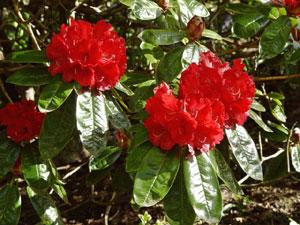
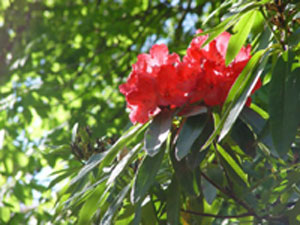
Begun in 1871 in a hidden valley, Glenfalloch Woodland Garden in Russell Bay on the Otago Peninsula offers rhododendrons, azaleas, magnolias and fushias set in a natural glen. Garden of National Significance.
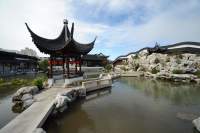
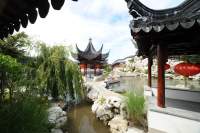
Dunedin’s newest garden is The Dunedin Chinese Garden which opened in late 2008 and immediately became the recipient of acclaim and awards. Built by The Dunedin Chinese Garden Trust, this is one of only three truly authentic gardens created outside China.
Please do make time to visit these most splendid gardens.
Dunedin City - New Zealand’s Most Beautiful City Award Winner (2008).
Dunedin Botanic Garden Only a 30 minute walk from the centre of town, Dunedin Botanic Garden is an oasis in the city. The world renowned Rhododendron Dell and the New Zealand Native Plant collection are set amongst wild native forest. The aviary displays native parrots and you can hear wild native birds as you sit on a sunny lawn overlooking nearby rural hills.
The flat lower botanic garden has formal displays of roses, herbaceous perennials and a rock garden, amongst others. The information centre, phone 477-4000, is open 363 days a year from 10am to 4pm and access to the botanic garden is free of charge and available from dawn till dusk. The winter garden glasshouse offers an all weather alternative and is close to the café.
A brochure is available from the information centre, detailing the accessibility rating of every track in the botanic garden.
Close to the heart of the city lies the Dunedin Botanic Garden, New Zealand''s first (established 1863), a garden of great variety. From the almost level area of the Lower Garden to the bush surrounded slopes of the Upper Garden, full advantage is taken of the topography and the range of microclimates to grow a diverse range of plants. These features, along with the mild climate of Dunedin, make this an ideal site for a botanic garden. Dunedin Botanic Garden aims to be a botanically and horticulturally recognised resource providing educational opportunity and a pleasant place for recreational enjoyment.  Centrally located in the Lower Garden is the restored Winter Garden. Opened in 1908, this Edwardian conservatory is used to cultivate plants which otherwise can not be grown in Dunedin. These include tropical and sub-tropical plants such as orchids, cycads and palms and from the arid regions - cacti and succulents. Also within the level area are to be found the Camellia, Herb, Water, Rose, Thematic plant, Herbaceous and Knot gardens. On the steep bank above the Lower Garden sprawls the massive Rock Garden containing alpine shrubs and trees, along with the more traditional diminutive rock and alpine herbs.
The Upper Garden contains plants from North Asia, North, South and Central America, South Africa and the Himalayas as well as an extensive Australian plant collection surrounding the aviary complex. The New Zealand native plant section is grown in borders according to distinguished features, natural habitats or origin. They include New Zealand wetland and alpine plants and a naturalistic bush environment as well as rare and endangered native plant species. The Azalea Garden with mature magnolias and maples, provides an attractive entrance to the Rhododendron Dell which was initially planted in 1914. Today it is a magnificent woodland garden featuring over 3,500 specimens.
The Garden is open from dawn to dusk every day and admission is free. It is a designated pedestrian area; animals are not permitted. An information centre, tea kiosk and playground, which are located in the Lower Gardens, are open daily from 10am-4pm. 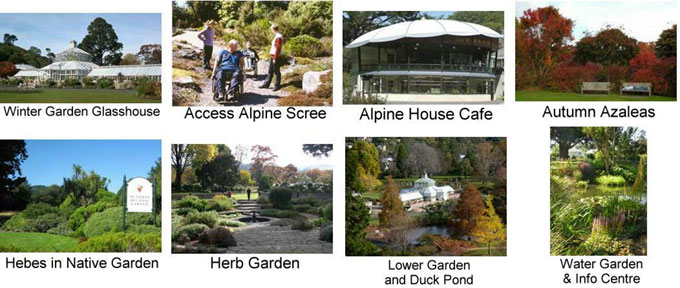
The Dunedin Chinese Garden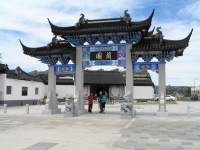
 * Award Winning Garden
* Air New Zealand Sister City Award
* Trust Power Dunedin Community Award
* New Zealand Post Local Government Excellence Award
The Dunedin Chinese Garden commemorates the contribution Chinese people have made, and continue to make, to Dunedin’s history, culture and ongoing prosperity.
The Dunedin Chinese Garden Trust lead the dream to create an authentic Chinese Garden in Dunedin, with support from the Shanghai Municipal Government and the Dunedin City Council.
The design of the Garden evolved over a period of eight years to ensure authenticity and cultural accuracy, as well as practical functionality. The Garden construction and design was closely supervised and influenced by the architect from the Shanghai Construction and Decoration Company, and the Shanghai Museum. 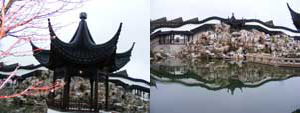
The Garden was pre-fabricated and assembled in Shanghai on a site identical in size and shape to that of Dunedin, then dismantled and transported to Dunedin where it was reconstructed on site using artisans and supervisors from Shanghai. 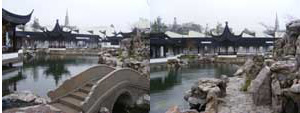
The Dunedin Chinese Garden is the only authentic Chinese Garden in New Zealand. It is the first in the Southern Hemisphere and one of less than a handful outside China. 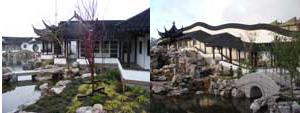
The Dunedin Chinese Garden Trust handed the Garden to the Dunedin City Council on completion to manage and ensure its continued authenticity and integrity as a lasting footprint of Chinese identity and culture. 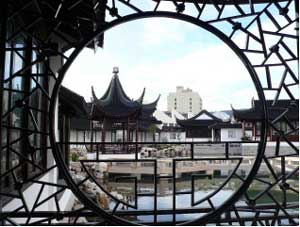
HOURS OF OPENING
Daily:10am – 5pm
Evening viewing: Wednesday 7pm – 9pm
Guided Tours: 10am and 2pm (or by appointment)
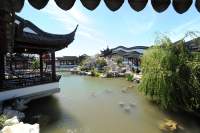
“Most cherished in this mundane world is a place without traffic; truly in the midst of a city there can be mountain and forest” Wen Zhengming(1470 - 1559)
 |
 |
 |
 There is always something to see in the gardens at Larnach Castle. The garden is Margaret Barker’s personal creation over 37 years and in 2004 was assessed as a Garden of National Significance by the New Zealand Gardens Trust www.gardens.org.nz (Royal New Zealand Institute of Horticulture www.rnzih.org.nz).
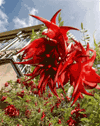 There is nothing like first hand research, knowledge and understanding gained by visiting these plants in their native habitats. Margaret has braved the roaring forties and furious fifties in a Russian polar explorer vessel to visit the Auckland and Campbell Islands and flown to the windswept Chatham Islands. She has also climbed Mt Gower in the pristine Lord Howe Islands, Cradle Mountain in Tasmania, The Andes in Chile and Argentina, where she camped amongst Monkey-Puzzle trees. Margaret’s interest in Southern Hemisphere plants has built up a great collection to be seen in the Castle grounds, with its variety of microclimates.
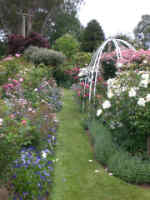
  The garden has something to catch your interest year round. After the Spring flowers - a fiery display of Azaleas in front of the Ballroom. The Laburnum Arch flowers in late November – a golden tunnel to delight. The Rock Garden shows its tiny treasures to the world once again right through Summer and Autumn. In January, giant lilies (Cardiocrinums) and flame creeper turn the Rainforest Garden into a scented and visual delight. The Serpentine Herbaceous Walk with its rose strewn trelliswork is like a basket overflowing with colour. At this time the gardens are popular for weddings, with such a wonderful setting for photographs.
  Come Autumn and the Heather Garden blooms complementing the Autumn foliage and bringing a Scottish mood to the Castle. The Autumn Crocus (Colchicums) line the Great Arch and hide amongst the Azaleas. In Winter you can appreciate the layout of the garden and also find a few brave flowers putting on their best faces. Snowdrops signal Winter’s end and the cycle starts again.
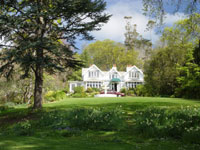
 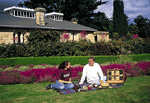 There is much to explore and enjoy for the whole family. Guests'' needs are well serviced with a licensed café by the open fire in the Ballroom, toilet facilities and a gift shop. There is also country inn-style Lodge Accommodation in the Castle grounds for those who wish to stay in this splendid setting. And of course there is always the Castle itself to explore. The Barker family have spent 37 years restoring the Castle to award winning splendour. The panoramic views from the tower 1,090 feet above sea level are well worth seeing and also provide an overview of the layout of the garden and the unique collection of NZ antiques and stories (a bit of scandal and tragedy) share the Castle''s history with visitors.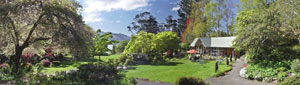

 Description:
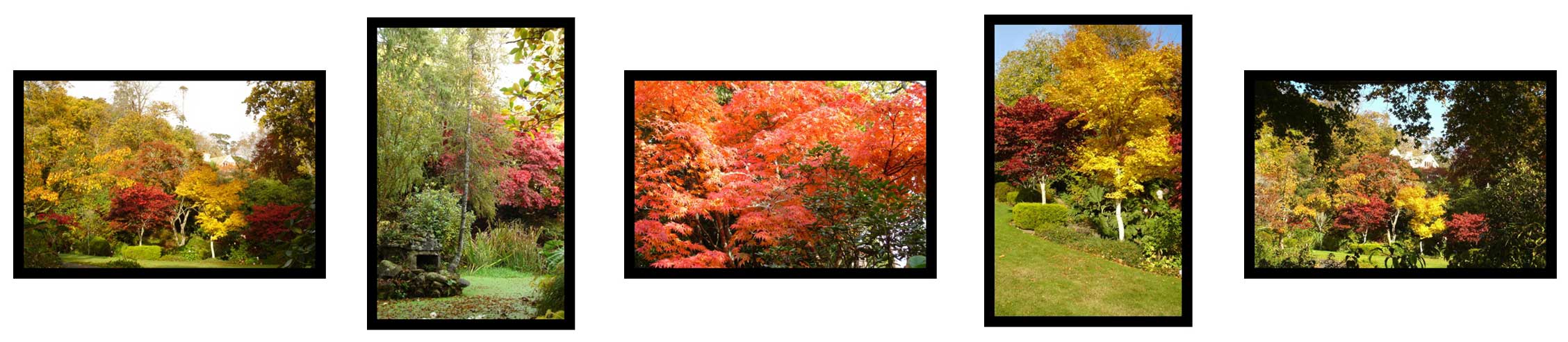
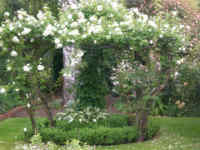
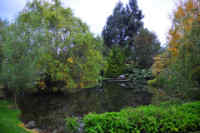
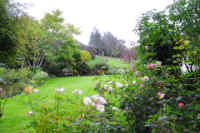
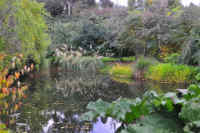
 Glenfalloch, Gaelic for ''hidden valley'', is located on the Otago Peninsula, just 15 minutes from Dunedin city - there are panoramic views stretching all the way down the harbour to Taiaroa Head. The garden''s 12 hectares, lying to the sun, are sheltered from the prevailing winds and rise 110 metres over its boundary length. There are many old oak, walnut, elm, horse chestnut, birch and English beech planted from 1872 giving an air of maturity. Glenfalloch was developed as a private garden from 1917 when many rhododendrons and azaleas were planted - these with Prunus and Magnolia are best seen in spring. In autumn the garden is a multitude of colours with maples
 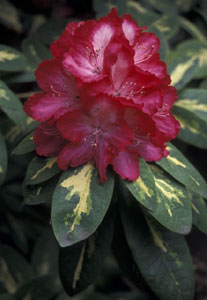 contributing a splash of brilliance. Many flowering and fruiting native plants have been established to attract birds adding a further touch. A cafe and restaurant cater to the public while the old Glenfalloch homestead watches from above. Now owned by the Otago Peninsula Trust the garden is currently being restored. Guided tours are available at a cost of $6 per person. Prior arrangement required.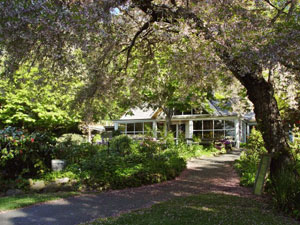
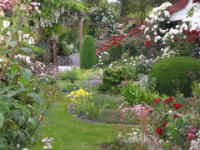
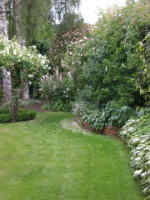
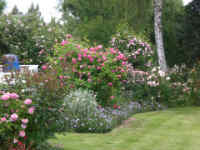
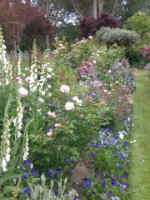
 Garden Features:
 |
 |
 |
 |
 |
 |
 |
 |
 |
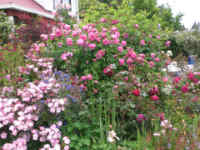
Location: 132 North Taieri Road, Abbotsford, Dunedin 9018
Contact: president@heritageroses.org.nz or wylde.willow@xtra.co.nz (Fran)
Phone: +64 3 488 3988
Oamaru Public Gardens
| Address: | 1 Thames Street |
| Oamaru | |
| Phone: | +64 3 434 1656 |
| Fax: | +64 3 434 1657 |
| Postal: | C/- Waitaki District Council |
| Private Bag 50-058 | |
| Oamaru | |
| New Zealand |
Bannerman Park, Gore
Bannerman Park was named in 1977 in honour of Mr R B Bannerman, whose foresight helped procure extra land for the park. Known as the Hidden Valley, the land dates from the 1870''s. Since then herbaceous perennials have been extensively planted. Today, streams, bordered by sealed pathways, meander throughout the valley. The daffodils, meconopsis, camellias, cherry blossom and magnolias announce early spring. The rhododendron collection includes large beds of R. yunnanense, R. decorum and R. spinuliferum all grown from seed gathered in the wilds of the Yunnan Province in China. In November the streams and ponds are lush with gunneras, hostas, irises and candelabra primulas. Native ferns, astelias and Chatham Island forget-me-nots also edge the streams. Peonies, daylilies and ajuga groundcover add to the colour as summer progresses. The deciduous foliage provides brilliant autumn colour from the weeping maples to the oaks, twisty willows and silver birches shading the picnic tables. Then winter brings the hellebores into flower. Most of the plants in the park are named. Stout walking shoes recommended.
Dolamore Park Scenic Reserve, Gore
Dolamore Park is named in honour of the Dolamore family whose gift allowed the camping area to be developed. The Gore Borough Council originally bought the land in 1940 to establish a public picnic area and provide access into the adjacent Croydon Bush Scenic Reserve in order to maintain it as a wildlife sanctuary. Walking tracks enable visitors to view the native birdlife, such as wood pigeons, fantails, bellbirds and tui especially in spring when the kowhai and flax flower. This native forested area forms a green backdrop for the park and is the largest lowland broadleaf Podocarp forest in the region, featuring substantial stands of southern rata and rimu, totara and matai over 500 years old. The Waimumu Stream and Whisky Creek running through the park are home to trout, eels, crayfish, ducks, geese and native shags, herons and kingfishers. Extensive lawns are bordered by stonewall terracing. In spring the mature rhododendrons feature, followed by the red rata flowers in summer. Fine selections of conifers can be seen in the Bert Newman Arboretum and the Ian Gilchrist Conifer Collection. The park includes a children''s playground and is popular for picnics, parties, barbecues and camping. A country music festival is held here each February. An Education Centre is open by appointment, displaying interactive information, which shows the balance of biodiversity in native forests. Stout walking shoes recommended.
Gore Public Gardens
The land was originally set aside in 1874, but not laid out until 1906 by David Tannock of Dunedin. The present design is based on this historic layout and incorporates many mature trees such as the gigantic Wellingtonia and horizontal elms planted at that time. Among the exotic trees and shrubs are a number of rare and unusual specimens including those in the extensive conifer border. Spring bulbs are accompanied by the camellias, magnolia and enkianthus trees flowering. Then Gore''s Rhododendron Festival is held each year in the Gardens in October, complemented by the spring bedding display of annuals. Tree peonies are a feature, the peony border being spectacular in November. This is followed by the roses, modern varieties making an impressive display through the summer months when the eucryphia trees blossom. Further annuals continue into the autumn as the deciduous foliage begins to turn on the maple trees, and enkianthus becomes a bright red and red berries appear on the sorbus trees. Winter features include the witch hazels, which bear yellow flowers on bare branches after the yellow autumn foliage drops. Hawthorns (Crataegus) produce red berries through the winter after the white blossom finishes. The conifer border is also a winter attraction and the Winter Garden complex is open all year. An added feature is the aviary, especially in spring. Stout walking shoes recommended.
Invercargill’s Parks and Gardens
Invercargill abounds with superb parks and gardens, ranging from the peaceful dignity of Anderson Park to the gracious opulence that is Queens Park. For a city of just 50,000 people, they are a treasure that the citizens can be truly proud of.
Each park charms with its own identity!
Whether it be by simply smelling the roses, testing your skill on a golf course, or appreciating the quality of art – take time to explore nature at its most noble and preservation at its proudest …
QUEENS PARK
Without doubt, Queens Park is the grandest of all the city’s parks; encompassing more than 80 hectares, it also offers the visitor the most diverse range of facilities and attractions.
One of the principal entrances to Queens Park is through the elegant Feldwick gates. An ideal way to get your bearings is by wandering along the tree-lined (Silver Birch and English Beech) Coronation Avenue, which leads from the gates, through the centre of the park to the band rotunda and beyond. All points of interest are easily accessed from this stunning walkway.
One of the park’s major attractions is the Southland Museum and Art Gallery. Located adjacent to the Feldwick Gates, the giant pyramid shaped roof is a feature in itself. Be sure to witness the only living relic of the dinosaur era – the tuatara. A successful breeding programme is currently in place at the museum tuatarium. While at the museum, experience a touch of local history – marvel at exhibits of nautical interest including those of early whaling. Don’t miss the unique exhibition of New Zealand’s Subantarctic Islands, it includes a spectacular audio-visual presentation.
The Invercargill Visitor Information Centre is located in the museum foyer.
Both the Museum and Visitor Information Centre are open weekdays from 9:00am – 5:00pm; weekends and public holidays from 10:00am – 5:00pm.
Beside the museum is an Observatory. It is open to the public from April to October on Wednesdays from 7:00pm – 9:00pm..
The Queens Park Garden is a mecca for those interested in horticulture. Its numerous botanical attractions provide vibrant displays whatever the season. Among its most prized are the Jessie Calder Gardens, featuring a large collection of old fashioned shrub roses, and the Henry Edginton Rose Garden, which harbours a range of modern roses including bush, standards and climbers. There is an azalea garden and a rhododendron dell – these provide dazzling, long-lasting displays during the early summer months. The all season indoor Winter Garden features lush tropical and flowering indoor plants – an adjoining house exhibits a variety of cacti.
The park’s most recent addition is the Japanese Garden, with its design dating back 1,000 years. It incorporates mountains, a waterfall, a river of pebbles and Japanese lanterns. The large stones placed around it represent either animals or some part of nature.
There are also significant areas of New Zealand native plants, rock and herb gardens. To enhance these majestic grounds, a variety of mature specimen trees and shrubs are located throughout the park.
In 1857 during the initial surveying of Invercargill, Queens Park was originally set aside as a bush reserve. However, at first much of it was let out for grazing, and large plantings of radiate pine and macrocarpas ensued. Today we enjoy those same trees – many plantings are more than 100 years old.
FACILITIES
A network of paths and tracks allow exploration at leisure. For the energetic the four kilometer fitness trail will indeed test your ability.
Queens Park is also popular with children! There is endless entertainment available for youngsters. The Wonderland Castle is an ideal place to start. Nearby is the bronze Peter Pan Statuary and adjacent to this are the children’s playground and splash pool.
The aviary has an extensive collection of birds and, like the animal enclosures, this is popular with all ages. Wild ducks are present all year round on the pond.
Thanks to the forethought of the early developers Queens Park today boasts a variety of excellent sporting facilities. Among these is the Queens Park Golf Club’s 18 hole golf course – visitors are most welcome. There is also a first class cricket wicket within the park grounds. Other sports catered for include bowls, tennis, squash, hockey, croquet and petanque.
There are two excellent cafés in Queens Park. The Pyramid Café is located in the foyer of the Southland Museum, and the Kiosk is near the children’s playground.
ANDERSON PARK
The gracious Georgian-style mansion and park land was gifted to the city of Invercargill in 1951.
The 24 hectares on show today were originally part of a large block of farmland known as Victoria Park. In 1910, prominent businessman, Robert A Anderson (later Sir Robert) purchased a rather neglected 300 acre block. The 50 acres of native bush on the property had attracted him.
Initially, he developed the property as a sheep farm, but his passion for horticulture soon saw Sir Robert and Lady Anderson planning extensive flower gardens. However, it wasn’t until 1925 that their magnificent homestead was completed. It was built at a cost of approximately $30,000 - roof slates were imported from Bangor, Wales. White plaster interior walls were chosen, in order to hang to advantage Sir Robert’s collection of paintings and etchings.
Maori artifacts were another of his great interests. Genuine carved pieces from the Ngati Tarawhai tribe in Rotorua were used to construct a replica Maori Whare Whakairo (carved house). After a completion of the Whare Whakairo, the family installed a sprung dance floor – informal dances were sometimes held.
R. A. as he was affectionately known, was a generous man and it was his wish upon the couples death, that the residence and grounds, including the block of native bush, be gifted to the city for use as a public park.
The native bush covering most of the park is typical of that which originally covered much of the Southland Plains.
A well defined walking track, suitable for wheelchairs, leads the visitor on a short circuit through its interior. It passes by a variety of vegetation, but the tall trees are primarily kahikatea, rimu, thin-barked totara, matai and miro. The principal canopy tree is the pokaka. However, without doubt the most noted tree on the property is the monkey puzzle tree (Araucaria araucana). It was planted more than 60 years ago, and is located near the car park.
Each spring and summer, the landscape is coloured by thousands of flowering annuals. For the rose lover, two separate gardens have been developed, one of which is a garden of miniature roses.
The spacious grounds also include a children’s playground, and wonderful picnic and wedding area.
The Andersons’ elegant home now houses the Anderson Park Art Gallery Society’s splendid collection of quality New Zealand art. This collection has grown steadily since the Society’s inception in 1951.
Entry to the art gallery is free except during exhibitions, and it is open daily from 1.30pm – 5.00pm. Closed Mondays. Anderson Park is located just 7km north of the city centre. Entry is off McIvor Road, which runs off North Road (SH6).
OTEPUNI GARDENS
Popular shaded pathways, winding along the banks of the Otepuni Stream make a refreshing break from the hustle and bustle of the city’s commercial centre.
Otepuni Gardens once claimed the role as the main city park, complete with nursery, display houses and aviaries, but that is a by-gone era – and gone too are most of those features; however, their charm and beauty remain. The spacious 9.4 hectares, encompassing four city blocks, are an important central landmark, and joggers and cyclists take advantage of the sense of seclusion the gardens offer.
The Puni Creek, as it is commonly known, was straightened from its original course, to allow for drainage, and town planning. Several years ago, major flood protection work necessitated the construction of stop banks; this enhanced the Otepuni Gardens, and today they continue to provide a peaceful sanctuary for city workers, shoppers and local residents.
For further information contact:
| Invercargill Visitor Information Centre Southland Museum and Art Gallery
|
Or | Parks Office
|
Sandy Point – Invercargill’s Natural Playground
Origins
In geological terms, Sandy Point is very young. The peninsula of sand, gravel and water-borne silt probably appeared some 4,000-5,000 years ago when sea levels were higher.
Old gravel storm beaches and ancient sand dunes are the main landscape features, forming low parallel ridges. Lagoons that once occupied the troughs between ridges have mostly disappeared. The largest remaining lagoon (and only source of fresh water) is Silver Lagoon.
A rich human history
Long before the site of Invercargill was developed, the rich natural resources of Sandy Point supported an important Maori settlement/kainga called Oue. The arrival of sealers and whalers brought change, although the whaling station established there in 1836 was short-lived.
Owen McShane was Sandy Point’s first European settler. While Maori valued the once abundant groves of cabbage tree/ti kouka for food and clothing, McShane became notorious for the rum he distilled from its roots.
Whalers became farmers. By the 1880’s, over-grazing, fire and the liberation of rabbits had created serious erosion problems. Forestry replaced farming and dune planting programmes eventually stabilized the shifting sand.
Until 1929, the estuary was Sandy Point’s only highway. Today, Sandy Point is a ten minute drive from Invercargill – an outstanding natural playground (over 2,000 hectares) of beach, river, estuary and forest. It is managed as a recreation reserve by the Invercargill City Council and is home to some 25 clubs and sporting organizations.
Forest – native and plantation
Sandy Point’s ancient sand dune forest of wind-sculpted totara and matai is rare and nationally important. Totara remains dominant, despite some milling at Daffodil Bay and Kilmock Bush in the 1880’s. Other native podocarps include rimu, miro and kahikatea.
Native forest walks reveal a rich wildlife community from the shaded, ferny floor upwards. By contrast, the open pine plantations seem lifeless and better suited to recreational pursuits like mountain-biking. Yet these forests also support wildlife, particularly on their outer edges.
Estuary and Wetland
The estuarine mudflats and salt marshes which fringe the Oreti River are also home to prolific plant and animal life. At least 15 different fish species have been recorded. For some, like eels/tuna, glaxiids (which include whitebait) and sea-run trout, the estuary is part of a migration route. For several flounder species, its sheltered waters provide a commercially important nursery.
Abundant food attracts large numbers of birds, including migratory waders and waterfowl. This wildlife diversity extends inland to Sandy Point’s freshwater lagoons and flooded gravel pits, providing a drawcard for fishermen, birdwatchers, photographers and educational groups.
The New River Estuary is part of the Awarua Wetlands, one of the largest wetland complexes in New Zealand and proposed as a Wetland of International Importance.
Exploring on foot
A 13.5km network of well-formed, signed walking tracks makes it easy to explore Sandy Point on foot. Some of the more popular tracks are introduced below.
Hatch’s Hill Lookout (5 minutes one way)
The track is signed at the turn-off to Noki Kaik Beach. The lookout provides panoramic views across the New River Estuary to Invercargill and south to Bluff and Stewart Island. The track continues to the picnic area at Noki Kaik beach (15 minutes one way).
Daffodil Bay to Hatch’s Hill (45 minutes one way)
The track entrance is signed from the picnic area. It combines good estuary views with the unusual totara-matai forest so characteristic of this area.
McShane’s Track (25 minutes return)
The track starts opposite the settlement at Cooper’s Creek and passes through an attractive remnant of native forest. At the Loop Road, cross the traffic barrier and turn left to return to Cooper’s Creek.
Kilmock Bush (30 minutes return)
This loop walk starts from Fosbender Park. It is a gently undulating track through a carpet of bush lily/astelia and hound’s tongue fern/kowaowao, beneath gnarled totara trees.
Petrie’s Track(20 minutes one way)
A popular, open walk through pine plantation to Daffodil Bay. The track is signed off the Daffodial Bay Road, some 500m beyond the Water Ski and Runabout Club.
Location
Sandy Point is 7km west of Invercargill. The Dunns Road bridge over the Oreti River marks the entrance to the recreation reserve. Directions to the various recreation facilities are signposted off Dunns Road and also displayed outside the Visitor Centre on Sandy Point Road.
Picnic Sites
Large groups are encouraged to book picnic sites through the Parks Division Office. Use gas barbeques only.
Contact the Parks Division
for further information on recreational opportunities and features of natural and historic interest
| Phone: | +64 3 217 7368 |
| Fax: | +64 3 217 5358 |
www.gardenscience.co.nz Science Behind Your Garden
|
|
|
|
|
|
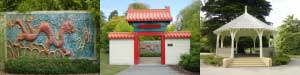
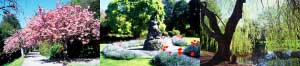
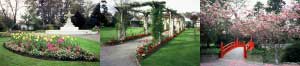
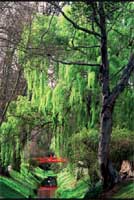 The Rhododendron Dell and Azalea Lawn provide a rainbow of bright colours during Springtime and the explosion of subtle pink and white shades from the Cherry Walk is breathtaking. The onset of Summer brings out the full splendour of the attractive bedding plants and the Rose Gardens come alive with colour and perfume. Fuschia and Erica Gardens surround the Wonderland Gardens on one side, whilst on the other is an impressive native plant section – mature trees, shrubs and ferns from across New Zealand, all labeled to help you identify them.
| This Site © A To Z Publications Ltd, New Zealand, 1997 - 2026. Enquiries to info@atoz-nz.com |